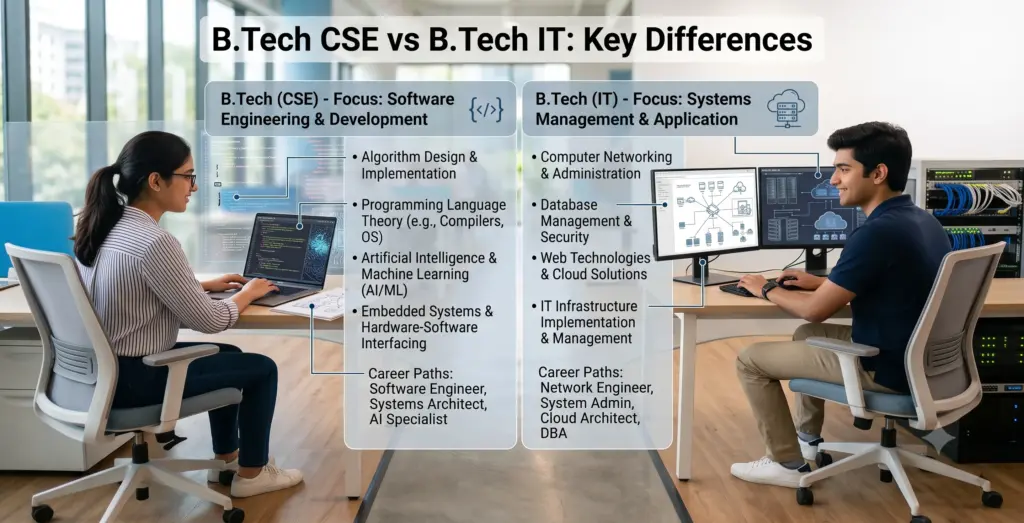
B.Tech CSE vs B.Tech IT: Key Differences
Summary
- B.Tech CSE (Computer Science Engineering) focuses on the theoretical and creative side of computing: algorithms, software architecture, and system design.
- B.Tech IT (Information Technology) focuses on the applied side: deploying, managing, and maintaining technology systems within organisations.
- Both are four-year, AICTE-approved undergraduate engineering program with a common first year before subjects diverge.
- CSE graduates typically move into software development, AI/ML, and research-driven roles; IT graduates typically move into network administration, system analysis, and IT infrastructure roles.
- Starting salaries are broadly comparable, though CSE has historically skewed slightly higher in product-based companies; the gap narrows significantly with skills, certifications, and portfolio strength.
- The right choice depends on whether a student is drawn to building new technology (CSE) or applying and managing existing technology (IT).
What is B.Tech CSE vs B.Tech IT?
B.Tech CSE is a four-year undergraduate engineering degree centered on the theoretical foundations of computing, programming, data structures, algorithms, and software development.
B.Tech IT is a four-year undergraduate engineering degree centered on the practical application of computing technology, covering networking, database management, and system administration, to solve real-world business problems.
CSE full form: Computer Science Engineering. IT full form: Information Technology. Both are distinct from “CS” (Computer Science), a term sometimes used interchangeably with CSE but which, at some universities, refers to a separate B.Sc-level or theory-only stream rather than the engineering degree. In casual usage, “Computer Science vs Information Technology” and “CSE vs IT” refer to the same comparison.
Key Differences
| Parameter | B.Tech CSE | B.Tech IT |
| Core Approach | Theory-driven; “creating” technology | Application-driven; “using” technology |
| Focus Areas | Algorithms, software architecture, computation theory | Networking, database administration, system deployment |
| Mathematical Depth | Higher | Moderate |
| Research Orientation | Stronger | Limited |
| Curriculum Divergence | From Year 2 onward (Year 1 is common) | From Year 2 onward (Year 1 is common) |
| Admission Process | Same as IT — JEE Main / entrance exam + counselling | Same as CSE — JEE Main / entrance exam + counselling |
Curriculum Comparison
| Subject Area | B.Tech CSE | B.Tech IT |
| Programming | Advanced DSA, compiler design, theory of computation | Application programming, scripting |
| Systems | Operating system internals, computer architecture | System administration, IT infrastructure |
| Data | Database systems, big data, AI/ML | Database management, data warehousing |
| Networks | Computer networks (foundational) | Networking, network security (in-depth) |
| Emerging Tech | Artificial intelligence, machine learning, data science | Cloud computing, cybersecurity operations, IoT |
Career Opportunities: CSE vs IT
| B.Tech CSE Roles | B.Tech IT Roles |
| Software Developer / SDE | Network Administrator |
| AI/ML Engineer | System Analyst |
| Data Scientist | Database Administrator |
| Research Engineer | IT Consultant |
| Backend/Full-Stack Developer | Cloud Support Engineer / IT Director (senior track) |
In practice, hiring for many software roles has become largely branch-neutral. Recruiters increasingly evaluate demonstrated skills, coding ability, and project experience over the degree title itself, particularly for service-based and product companies hiring at scale.
Salary Comparison
| Experience Level | B.Tech CSE (Typical Range) | B.Tech IT (Typical Range) |
| Fresher (0-1 year) | ₹4 LPA – ₹8 LPA | ₹3.5 LPA – ₹6 LPA |
| Mid-Career (3-5 years) | ₹10 LPA – ₹20 LPA | ₹8 LPA – ₹15 LPA |
| Senior / Specialised (5+ years) | ₹20 LPA – ₹35 LPA+ | ₹12 LPA – ₹25 LPA |
Salary figures are indicative, compiled from industry salary trackers and multiple placement reports, and vary significantly by company type, city, and specialisation. IT graduates with strong cloud, cybersecurity, or consulting skills can match or exceed CSE salary bands in specific roles.
Expert Insight
Industry Perspective: Recruiters increasingly hire on demonstrated skill rather than degree title alone. A CSE graduate weak on practical deployment or an IT graduate strong in DSA can each outperform expectations tied to their branch name.
Academic Perspective: Colleges are converging first-year fundamentals across CSE and IT, then diverging from Year 2, which means the actual differentiation happens through electives, specialisations, and internship choices rather than the degree label alone.
Which One Should You Choose?
Neither branch is universally “better”; the right fit depends on personal interest and career direction.
B.Tech CSE may suit you if:
- You enjoy mathematics, logic, and algorithmic problem-solving
- You want to build new software, AI models, or research new technology
- You are considering higher studies (M.Tech, MS, or PhD) in a technical specialisation
B.Tech IT may suit you if:
- You are more interested in applying and managing existing technology than building it from scratch
- You enjoy working with networks, databases, and organisational IT systems
- You want a career blending technical skills with business or infrastructure management
B.Tech CSE at NGFCET
NGFCET currently offers B.Tech in Computer Science Engineering, along with specialisations in AI & ML and Cyber Security, delivered with an industry-aligned curriculum, 550+ hours of DSA training, and structured placement preparation. Students interested in the applied, IT-management side of computing can also explore NGFCET’s B.Sc in Information Technology, a separate 3-year programme focused on practical IT foundations. For full eligibility, fees, and curriculum details on the CSE route, see our detailed B.Tech CSE curriculum and career breakdown.
Frequently Asked Questions
No. While the two overlap in early coursework and share a common first year, CSE and IT are distinct branches with different core focuses, CSE on computing theory and software creation, IT on applying and managing technology systems.
Neither is universally better; it depends on your interests. CSE suits students drawn to algorithms, software creation, and research, while IT suits students who prefer applying and managing existing technology systems. See the “Which One Should You Choose?” section above for a fuller breakdown.
CSE salaries tend to run slightly higher on average, particularly in product-based companies and specialised roles like AI/ML, but the gap narrows considerably with experience, certifications, and skill specialisation, IT professionals in cloud, security, or consulting roles can match or exceed CSE pay bands.
CSE is generally considered more mathematically and algorithmically intensive, while IT places more emphasis on application and systems management, which some students find more approachable.
Yes. IT graduates with strong programming skills can and do work as software developers, particularly in service-based companies, startups, and roles that prioritise applied coding ability over theoretical depth.
CSE generally has broader global demand, especially in AI, data science, and full-stack development roles, though IT skills in cloud and enterprise systems remain in steady demand internationally as well.
Yes. Both CSE and IT graduates can pursue cybersecurity careers; IT’s networking and systems focus provides a natural foundation, while CSE’s programming depth supports roles like security research and tool development.
Yes, in most Indian engineering colleges, the first year covers common engineering fundamentals, with CSE and IT curricula diverging from the second year onward.
Dr. Vinod Kumar is a distinguished academic leader serving as the Dean, NGFDC, Dean (University Affairs), and Head of the Department of Electrical Engineering & Electronics and Communication Engineering (EE & ECE). He is committed to advancing academic excellence through quality teaching, research, curriculum innovation, and institutional leadership. His expertise spans electrical and electronics engineering, academic administration, and industry-oriented education. Through his leadership, he actively promotes innovation, interdisciplinary learning, faculty development, and student success, preparing graduates to excel in a rapidly evolving technological landscape.