B.Tech in Artificial Intelligence: Eligibility, Curriculum, Salary and Career Scope (2026 Guide)
Quick Summary
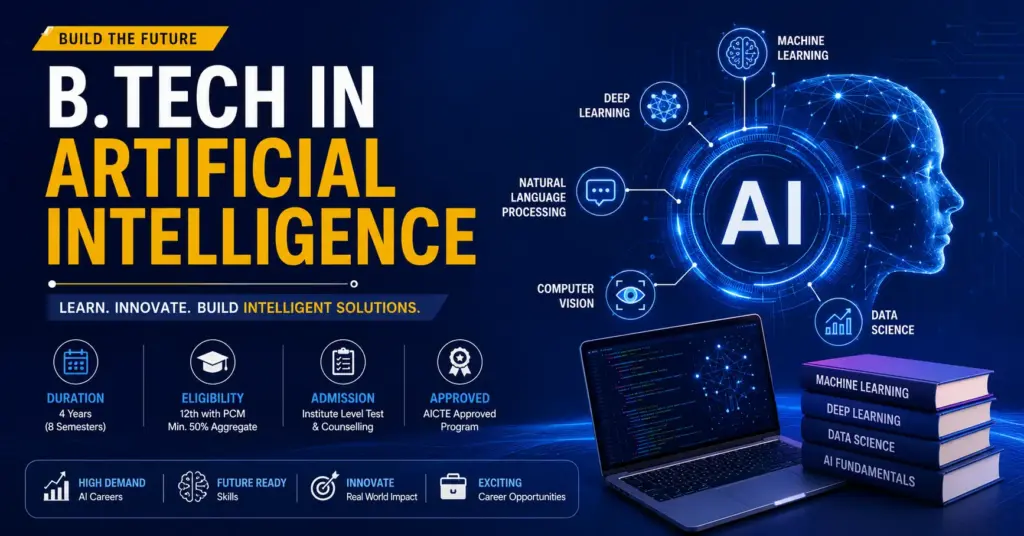
- B.Tech in Artificial Intelligence is a 4-year undergraduate engineering programme that combines core computer science with specialised AI and machine learning training.
- Eligibility typically requires passing Class 12 with Physics, Chemistry and Mathematics, generally with a minimum of 50% aggregate marks.
- Admission at most private engineering colleges is based on an institute-level entrance test or counselling process rather than JEE Main alone.
- Average fresher salary for AI engineering roles in India ranges from ₹7.7 LPA to ₹11.9 LPA, according to AmbitionBox (2026), with senior roles crossing ₹17.8 LPA.
- Career roles include AI Engineer, Machine Learning Engineer, Data Scientist, NLP Engineer and Computer Vision Engineer.
- Industry demand is rising sharply, with NASSCOM’s 2025 Strategic Review noting that AI-led digital spending is now a primary growth driver for India’s technology sector.
- NGFCET offers B.Tech (CSE) with a specialisation in AI & ML, delivered as an AICTE-approved, industry-aligned programme in Faridabad.
What is B.Tech in Artificial Intelligence?
B.Tech in Artificial Intelligence is a four-year undergraduate engineering degree in which students study core computer science subjects alongside specialised courses in machine learning, deep learning, natural language processing and computer vision. The programme prepares students to design, build and deploy AI-driven systems used across industries such as healthcare, finance, retail and manufacturing.
Artificial Intelligence (AI), as a field, refers to the branch of computer science focused on building systems that can perform tasks that normally require human intelligence, such as recognising patterns, making predictions and processing language. A B.Tech specialisation in this area is typically offered as “B.Tech CSE (AI & ML)” or “B.Tech in Artificial Intelligence and Data Science,” depending on the affiliating university’s nomenclature.
Why Choose B.Tech in Artificial Intelligence?
Artificial Intelligence has moved from a niche specialisation to one of the most in-demand engineering branches in India. A few factors are driving this shift:
- Rising enterprise AI adoption. NASSCOM’s AI Adoption Index puts India at 2.45 out of 4, with 87% of enterprises actively using AI solutions as of December 2025.
- Strong hiring momentum in AI-specific roles. NASSCOM’s data on India’s services sector shows the hiring rate for AI engineering talent at 30%, placing India ahead of several advanced economies, alongside close to 100% year-on-year growth in prompt-engineering hiring through 2025.
- Cross-industry applicability. AI skills are now relevant well beyond IT services, spanning BFSI, healthcare, e-commerce, manufacturing and logistics.
- Higher earning potential relative to several other engineering branches, particularly for graduates who build strong project portfolios during their degree.
This growth also means competition for roles is increasing, so the quality of an institute’s curriculum, lab exposure and placement support matters as much as the degree title itself.
Eligibility Criteria for B.Tech in Artificial Intelligence
| Criteria | Requirement |
| Academic qualification | Passed Class 12 (or equivalent) with Physics, Chemistry and Mathematics |
| Minimum marks | Generally 50% aggregate (varies by institute and category) |
| Entrance route | Institute-level entrance test, counselling, or national/state engineering entrance exam, depending on the college |
| Age criteria | No standard upper age limit at most private institutes; varies by university |
Eligibility requirements can vary between universities, so candidates should always confirm the exact criteria on the admission page of the specific institute they are applying to.
Admission Process
Most private engineering colleges follow a broadly similar admission process for B.Tech, including AI-specialised tracks:
- Complete the online application form and upload Class 12 mark sheets and required documents.
- Appear for the institute’s own entrance test, or submit scores from an accepted national/state-level exam where applicable.
- Attend counselling or a review of academic performance and entrance scores.
- Confirm the seat through document verification and fee payment.
At NGF College of Engineering & Technology, B.Tech admissions, including the AI & ML specialisation, are processed through the institute’s own N-SAT entrance assessment. Applicants should verify current-year specifics such as accepted exams and application deadlines directly with the admissions team, as these are updated closer to each academic session.
Course Curriculum and Specialisation Areas
A typical B.Tech in Artificial Intelligence curriculum builds from core engineering fundamentals in the first year toward advanced AI coursework in later years.
| Year | Focus Area |
| Year 1 | Mathematics, programming fundamentals (C, C++, Python), physics and engineering basics |
| Year 2 | Data structures and algorithms, database management systems, computer networks, introduction to AI & ML |
| Year 3 | Machine learning, deep learning, natural language processing, computer vision, applied AI projects |
| Year 4 | Generative AI, AI for robotics, capstone project, internships and industry-mentored work |
Programmes with strong industry alignment typically add hackathons, live projects and certification tie-ups with technology providers such as Microsoft and AWS, alongside the core academic curriculum.
Skills Gained in B.Tech in Artificial Intelligence
- Python and AI-focused programming
- Machine learning model development and evaluation
- Deep learning and neural network design
- Natural language processing (NLP)
- Computer vision
- Data structures, algorithms and database management
- Applied problem-solving through capstone and live industry projects
Fee Structure
The total B.Tech (AI/ML) program fee at NGF College of Engineering & Technology is ₹4,40,000 for the 2026-27 admission cycle, comprising a tuition fee of ₹4,30,000 and a registration fee of ₹10,000, per the official Fee Structure 2026-27 page. Fees vary by institute, university affiliation, and whether the seat is under the general or scholarship category. Across private AICTE-approved engineering colleges in India, total B.Tech fees for AI/ML specialisations commonly fall in the range of approximately ₹4 LPA to ₹4.5 LPA for the full programme, though this varies by institute and region. This figure may be revised for subsequent academic years, and scholarship categories can reduce the effective payable amount, so candidates should confirm the latest applicable fee directly with the admissions office before applying.
B.Tech in Artificial Intelligence Salary in India
Salary in AI engineering roles depends heavily on experience level, company type and specialisation.
| Experience Level | Average Salary Range (per annum) | Source |
| Fresher (0–3 years) | ₹7.7 LPA – ₹11.9 LPA | AmbitionBox (2026) |
| Mid-level | ₹11.7 LPA – ₹16.2 LPA | AmbitionBox (2026) |
| Senior-level | From ₹17.8 LPA, with top performers significantly higher | AmbitionBox (2026) |
| Overall average (all levels) | Approximately ₹11 LPA | Glassdoor (2026) |
These figures represent industry-wide averages across India and are not specific to any single institute’s placement outcomes. Actual starting salaries depend on the recruiting company, specialisation, city and individual candidate performance.
Career Opportunities After B.Tech in Artificial Intelligence
| Role | What the Role Involves |
| AI Engineer | Designs and deploys AI models into production systems |
| Machine Learning Engineer | Builds and optimises ML algorithms and pipelines |
| Data Scientist | Analyses data to generate business and predictive insights |
| NLP Engineer | Works on language-based AI applications such as chatbots and text analytics |
| Computer Vision Engineer | Develops systems that interpret images and video |
| AI Research Associate | Supports applied or academic research in emerging AI techniques |
Graduates can also pursue higher studies such as an M.Tech or specialised AI/ML postgraduate programmes, or prepare for public-sector technical roles through exams like GATE.
B.Tech in Artificial Intelligence vs B.Tech in Computer Science (CSE)
A common question among Class 12 students is how an AI specialisation differs from a standard CSE degree. Both share the same core-engineering foundation in the first two years; the difference lies in later-year electives and project focus.
| Parameter | B.Tech (AI & ML specialisation) | B.Tech (CSE, general) |
| Core focus | Machine learning, deep learning, NLP, computer vision | Software development, databases, networks, systems |
| Later-year electives | AI-specific: applied AI, generative AI, robotics | Broader: cloud computing, cybersecurity, software engineering |
| Typical career path | AI/ML-focused roles | Broader software and IT roles |
For a detailed year-by-year breakdown of how a CSE degree differs from adjacent specialisations, see {{LINK_REQUIRED}}.
Is B.Tech in AI Possible Without JEE?
Yes. While government-funded institutes such as IITs and NITs require JEE Main or JEE Advanced scores, many private AICTE-approved engineering colleges admit students to B.Tech in Artificial Intelligence through their own institute-level entrance test or a direct counselling process based on Class 12 academic performance. Candidates should check each institute’s specific admission route rather than assuming JEE is mandatory across all colleges.
Frequently Asked Questions
Fresher salaries for AI engineering roles in India typically range from ₹7.7 LPA to ₹11.9 LPA, according to AmbitionBox (2026), rising significantly with experience and specialisation in areas like generative AI.
It is a strong choice for students interested in technology and data-driven problem-solving, given rising enterprise AI adoption and hiring demand reported by NASSCOM. As with any engineering branch, outcomes depend on the quality of the curriculum, project exposure and the student’s own skill-building.
Graduates can pursue roles such as AI Engineer, Machine Learning Engineer, Data Scientist, NLP Engineer and Computer Vision Engineer, across IT services, product companies, BFSI, healthcare and manufacturing, or opt for higher studies in AI/ML.
Yes. Many private engineering colleges admit students through their own entrance test or a direct counselling process rather than requiring JEE Main or JEE Advanced scores.
Both share a common first two years of core engineering subjects. B.Tech in AI adds specialised later-year coursework in machine learning, deep learning, NLP and computer vision, while general CSE offers broader electives across software development, networks and systems.
It is a four-year undergraduate programme divided into eight semesters, similar to other B.Tech specialisations.

Dr. Vinod Kumar is a distinguished academic leader serving as the Dean, NGFDC, Dean (University Affairs), and Head of the Department of Electrical Engineering & Electronics and Communication Engineering (EE & ECE). He is committed to advancing academic excellence through quality teaching, research, curriculum innovation, and institutional leadership. His expertise spans electrical and electronics engineering, academic administration, and industry-oriented education. Through his leadership, he actively promotes innovation, interdisciplinary learning, faculty development, and student success, preparing graduates to excel in a rapidly evolving technological landscape.