
BE vs B.Tech: What Is the Difference? Complete Comparison Guide (2026)
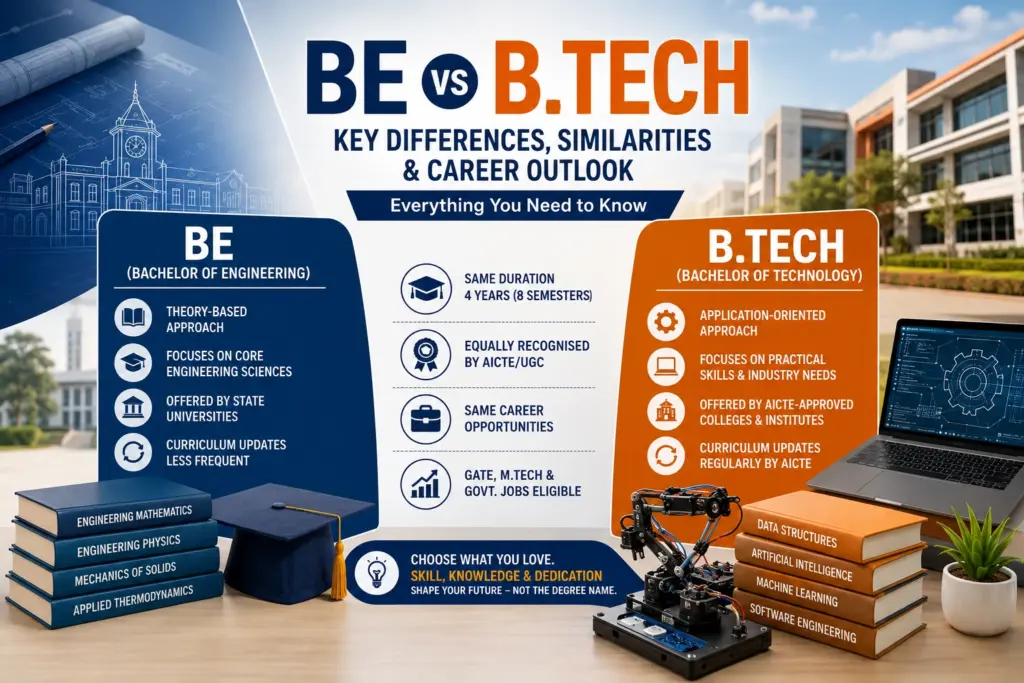
BE (Bachelor of Engineering) and B.Tech (Bachelor of Technology) are both four-year undergraduate engineering degrees recognised as equivalent by AICTE. BE follows a knowledge-based, theory-heavy curriculum, while B.Tech is application-oriented and updated more frequently to match industry needs. Eligibility, duration, and career outcomes are the same for both.
What Is BE (Bachelor of Engineering)?
BE, or Bachelor of Engineering, is a four-year undergraduate degree that focuses on the theoretical and scientific foundations of engineering. Universities that award a BE typically follow an academic model where curriculum revisions happen less frequently than in AICTE-regulated B.Tech programs.
BE degrees are commonly awarded by state universities and autonomous institutions such as Anna University and the University of Mumbai, among others. The degree structure covers core engineering sciences, mathematics, and discipline-specific theory across eight semesters.
What Is B.Tech (Bachelor of Technology)?
B.Tech, or Bachelor of Technology, is a four-year undergraduate engineering degree regulated by the All India Council for Technical Education (AICTE). It is application-oriented, with curriculum designed around practical skill-building, labs, and industry-aligned coursework.
Most engineering colleges established after the 1980s, including NGF College of Engineering & Technology’s AICTE-approved B.Tech programme, offer B.Tech rather than BE. Because AICTE reviews technical curricula on a regular cycle, B.Tech syllabi tend to be updated more often to reflect current industry practices, tools, and emerging technologies such as AI and data science.
BE vs B.Tech: Key Differences
| Parameter | BE (Bachelor of Engineering) | B.Tech (Bachelor of Technology) |
| Full Form | Bachelor of Engineering | Bachelor of Technology |
| Regulatory Focus | Often university-governed academic model | AICTE-regulated technical education |
| Learning Approach | Theory and knowledge-based | Application and skill-based |
| Curriculum Updates | Less frequent | Reviewed periodically by AICTE |
| Common Offering Institutions | State universities (e.g., Anna University, Mumbai University) | Most modern engineering colleges and technical institutes |
| Duration | 4 years (8 semesters) | 4 years (8 semesters) |
| Degree Level | Undergraduate (UG) | Undergraduate (UG) |
| Recognition | Recognised by AICTE/UGC | Recognised by AICTE/UGC |
Are BE and B.Tech Equally Recognised?
Yes. BE and B.Tech are treated as equivalent undergraduate degrees by the All India Council for Technical Education. Both qualify a student for postgraduate engineering admissions (M.Tech/ME), competitive exams like GATE, and government or private sector recruitment on the same terms.
The difference lies in academic emphasis, not in the value or acceptability of the degree. Employers, further-education institutes, and government bodies do not distinguish between the two labels when evaluating a candidate’s eligibility.
BE vs B.Tech: Curriculum and Teaching Approach
The core distinction between BE and B.Tech shows up in how the syllabus is structured and revised, not in the subjects covered in the first two years.
- BE programmes generally place greater weight on foundational engineering science, mathematics, and theoretical problem-solving. Curriculum revisions happen at the pace set by the affiliating university’s academic senate.
- B.Tech programmes are reviewed under AICTE’s technical education framework, which is designed to keep pace with evolving industry requirements. This often translates into more labs, live projects, internships, and exposure to current tools and technologies within the same four-year structure.
Both formats cover the same broad engineering disciplines Computer Science, Mechanical, Civil, Electrical, and Electronics with the difference lying in emphasis rather than scope.
Which Institutions Award BE vs B.Tech?
Whether a college offers a BE or a B.Tech depends on its affiliating university, not on the college’s academic quality.
- BE-awarding universities include Anna University (Tamil Nadu), University of Mumbai, and several other state universities with long-established engineering faculties.
- B.Tech-awarding institutes make up the majority of engineering colleges in India today, including AICTE-approved private colleges and most institutes affiliated with state technical universities such as J.C. Bose University of Science & Technology, YMCA.
A student comparing two colleges should treat the BE/B.Tech label as a secondary factor and focus on accreditation, placement record, and specialisation strength instead.
Eligibility and Admission Process
Eligibility criteria are identical for BE and B.Tech programs, since both fall under the same undergraduate engineering framework.
| Criteria | BE | B.Tech |
| Minimum Qualification | Class 12 with Physics, Chemistry, Mathematics (PCM) | Class 12 with Physics, Chemistry, Mathematics (PCM) |
| Minimum Marks | Typically 45–50% (varies by institute) | Typically 45–50% (varies by institute) |
| Entrance Exams | JEE Main, state-level exams, university-specific tests | JEE Main, state-level exams, university-specific tests |
| Admission Mode | Counselling or direct application | Counselling or direct application |
| Lateral Entry | Available via diploma or B.Sc route | Available via diploma or B.Sc route |
The admission process generally includes entrance exam registration, result declaration, counselling or direct application, document verification, and fee payment regardless of whether the college awards a BE or a B.Tech.
Career Opportunities and Salary: Does the Degree Name Matter?
Career outcomes for BE and B.Tech graduates depend primarily on specialisation, college reputation, and individual skill-building not on whether the degree certificate reads “BE” or “B.Tech.” There is no single official government dataset that reports salary outcomes separately by degree name, since AICTE and UGC track degree recognition rather than pay.
Recruiters evaluate candidates on branch, project experience, internships, and technical proficiency. A Computer Science graduate with a BE and one with a B.Tech from comparable institutes are assessed on the same criteria during placements.
| Branch | Indicative Fresher Salary Range (Annual) |
| Computer Science / IT | ₹3.5–7 LPA |
| Electronics & Communication | ₹3.5–6 LPA |
| Mechanical Engineering | ₹2.5–6 LPA |
| Electrical Engineering | ₹2.8–6.5 LPA |
| Civil Engineering | ₹2.5–6 LPA |
Industry Perspective
Recruiters in IT, core engineering, and product companies typically screen for branch relevance, hands-on project work, and problem-solving ability rather than the BE/B.Tech distinction on a resume.
Academic Perspective
For students planning to pursue M.Tech, MS abroad, or research roles, both degrees are treated as equivalent qualifying credentials by AICTE and most international credential evaluators.
Career Counsellor Perspective
Career counsellors generally advise students to prioritise the college’s engineering programme reputation and NGFCET’s presence as a higher education institute in Faridabad, placement record, and specialisation over the BE/B.Tech label itself.
Similarities Between BE and B.Tech
- Both are four-year, eight-semester undergraduate degrees.
- Both require Class 12 with Physics, Chemistry, and Mathematics.
- Both are recognised by AICTE and accepted for higher studies like M.Tech and GATE.
- Both lead to similar career paths across core engineering, IT, and management roles.
- Neither degree offers an inherent placement or salary advantage over the other.
BE vs B.Tech: Which Should You Choose?
In practice, most students do not choose between BE and B.Tech directly the degree name is determined by the university a college is affiliated with, not by student preference. If you are shortlisting colleges, it is more useful to compare specialisation options, curriculum currency, industry exposure, and placement support than to weigh the degree label on its own.
For a closer look at how specialisation choice affects outcomes within B.Tech itself, see NGFCET’s comparison of B.Tech CSE and B.Tech IT specialisations, which breaks down curriculum and career differences between two commonly compared branches.
Future Outlook: Does the BE/B.Tech Distinction Matter Going Forward?
The BE label is gradually becoming less common as more universities align with AICTE’s B.Tech framework, particularly for new-age specialisations like AI & ML, Data Science, and Cyber Security, which are introduced through the B.Tech route. Students researching colleges in 2026 are more likely to encounter B.Tech as the default nomenclature, with BE remaining largely at older, established state universities.
Frequently Asked Questions
Yes, in terms of recognition, duration, and eligibility, BE and B.Tech are treated as equivalent undergraduate engineering degrees by AICTE. The difference is in curriculum emphasis BE is more theory-based, while B.Tech is more application-oriented.
Neither degree has an inherent placement advantage. Placement outcomes depend on the college’s industry connections, the student’s branch, and individual skill development rather than the degree name.
Yes. Since AICTE recognises both degrees as equivalent, BE and B.Tech graduates are eligible for the same government and private sector roles, subject to branch and eligibility requirements specific to each job.
No. Both require Class 12 with Physics, Chemistry, and Mathematics, along with a qualifying score in relevant entrance exams such as JEE Main or state-level tests.
Yes. A BE degree is accepted for M.Tech admissions and GATE eligibility on the same basis as a B.Tech degree, as both are AICTE-recognised undergraduate engineering qualifications.
The degree nomenclature usually depends on the affiliating university’s academic framework. Older, university-governed programs often use “BE,” while institutes following AICTE’s technical education model typically use “B.Tech.

Dr. Vinod Kumar is a distinguished academic leader serving as the Dean, NGFDC, Dean (University Affairs), and Head of the Department of Electrical Engineering & Electronics and Communication Engineering (EE & ECE). He is committed to advancing academic excellence through quality teaching, research, curriculum innovation, and institutional leadership. His expertise spans electrical and electronics engineering, academic administration, and industry-oriented education. Through his leadership, he actively promotes innovation, interdisciplinary learning, faculty development, and student success, preparing graduates to excel in a rapidly evolving technological landscape.